Understand Semantic SEO! Search engines are now adults. They are no longer just matching strings of text; they are also reading for meaning. This change has brought us into the age of semantic search, where context is more important than exact keyword matches and intent is more important than exact keyword matches. This means that those of us who work in digital marketing need to update our old toolkits. Not only is Python a coding language, but it can also help you see your content the way Google does.
When we talk about semantic SEO, we are talking about building webs of meaning. It’s about ensuring your content answers the user’s intent comprehensively. By leveraging Python for Natural Language Processing (NLP), we can automate the heavy lifting of understanding these relationships. We can analyze thousands of search results in seconds, extract entities, and map out the topical authority required to rank. Let’s walk through how you can harness this power without needing a PhD in computer science.
Understanding the intersection of Natural Language Processing and Search
Before we start writing code, we need to understand the logic behind the machines. NLP is the branch of AI that gives computers the ability to understand text and spoken words in much the same way human beings can. When you apply this to search optimization, you start seeing patterns that remain invisible to the naked eye. Google’s algorithms, like BERT and MUM, use these very principles to decide if your page is worth ranking.
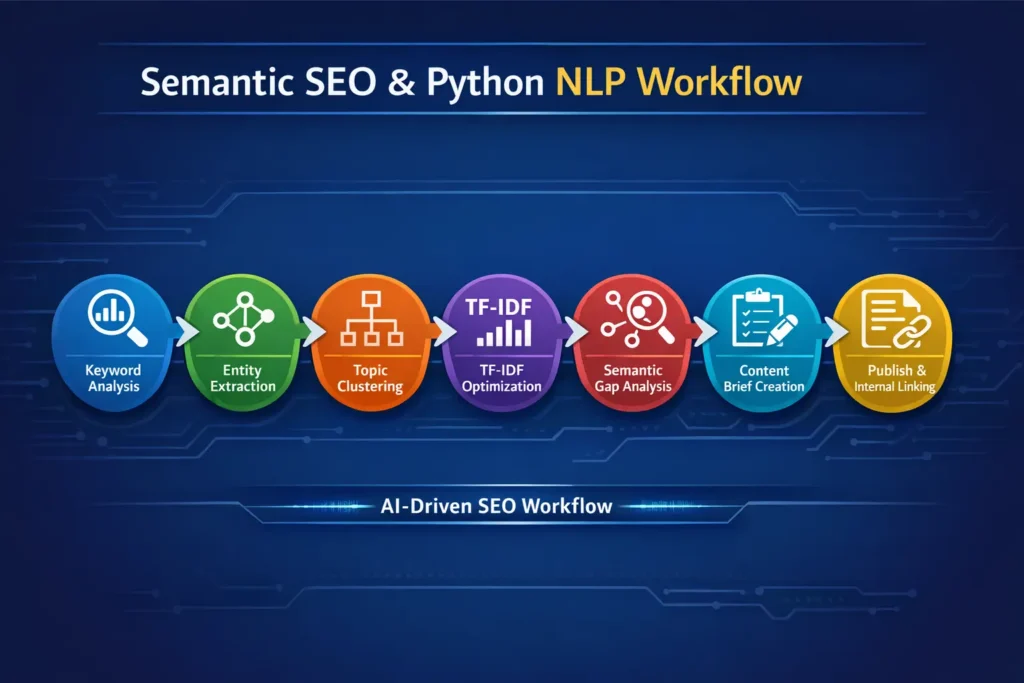
Using Python allows us to mimic these algorithms on a smaller scale. We can break down our content—and our competitors’ content—into machine-readable formats. This process reveals gaps in our topical coverage. It shows us not just which keywords are missing, but which concepts are missing. This is the difference between guessing what Google wants and knowing mathematically what satisfies the algorithm.
Why entity extraction matters for modern SEO strategies
Keywords are still useful, but entities are the real currency of the web today. An entity is a distinct, independent thing—a person, place, organization, or concept. Google builds its Knowledge Graph on these entities. If your content mentions “Apple,” Google needs to know if you mean the fruit or the tech giant. Semantic SEO is about making that distinction crystal clear through context.
Python libraries like SpaCy and NLTK can quickly scan your text and find these entities. You can find missing pieces of the puzzle by looking at the entities on top-ranking pages and comparing them to your own. You have a relevance problem if all of the top articles on “best running shoes” mention “arch support” and “durability” as important parts, but yours doesn’t. Fixing this helps you align perfectly with what search engines expect to see.
📌 Expert Note — Adrian J. Cole:
“Python reveals what your content means, not just what it says. Once you understand those hidden semantic signals, optimizing for search becomes far more predictable.”
Setting up your Python environment for text analysis
Getting started is often the hardest part. You don’t need a complex development environment to begin; a simple Jupyter Notebook will do the trick. This interactive interface lets you run code in chunks and see the results immediately, which is perfect for SEO analysis. You will need to install a few key libraries: pandas for handling data, requests for fetching web pages, and BeautifulSoup for cleaning up the HTML mess.
Once you have the basics, you bring in the heavy hitters for NLP. Libraries like spaCy are industry standards for industrial-strength text processing. Another great tool is gensim, which is fantastic for topic modeling. These tools turn raw text into structured data that you can actually measure and improve. It’s like turning the lights on in a dark room; suddenly, you can see exactly where the furniture is.
Automating competitor analysis with Python scripts
Imagine trying to read the top 10 results for a search query, taking notes on every topic covered, and comparing them manually. It would take hours. With Python, you can automate this entire workflow. You can write a script to scrape the content of the top-ranking pages for your target keywords.
Once you have that data, you can use frequency analysis to see which terms appear most often. But don’t stop at simple word counts. Use N-gram analysis (looking at sequences of two or three words) to find common phrases. This often reveals the sub-topics that competitors are discussing. If you are offering SEO services Florida, knowing exactly what local competitors are writing about gives you the blueprint to outrank them.
Leveraging Google’s NLP API for deeper insights
Sometimes, open-source libraries aren’t enough. You want to see exactly how Google interprets your text. Google offers a Cloud Natural Language API that allows you to feed it text and get back their specific analysis. This is the closest you can get to looking under the hood of the search engine itself.
The API provides a “salience” score for every entity it finds. Salience measures how important an entity is to the overall meaning of the text. If your target keyword has a low salience score in your own article, Google thinks your content is about something else entirely. Adjusting your writing to boost the salience of your core topics is a powerful way to improve your rankings.
Mapping topical authority using semantic distance
Topical authority isn’t just about writing a lot; it’s about covering a subject comprehensively. Python can calculate the “semantic distance” between words. This measures how closely related two concepts are in a vector space. If “SEO” and “content marketing” are close together, your content should probably bridge that gap.
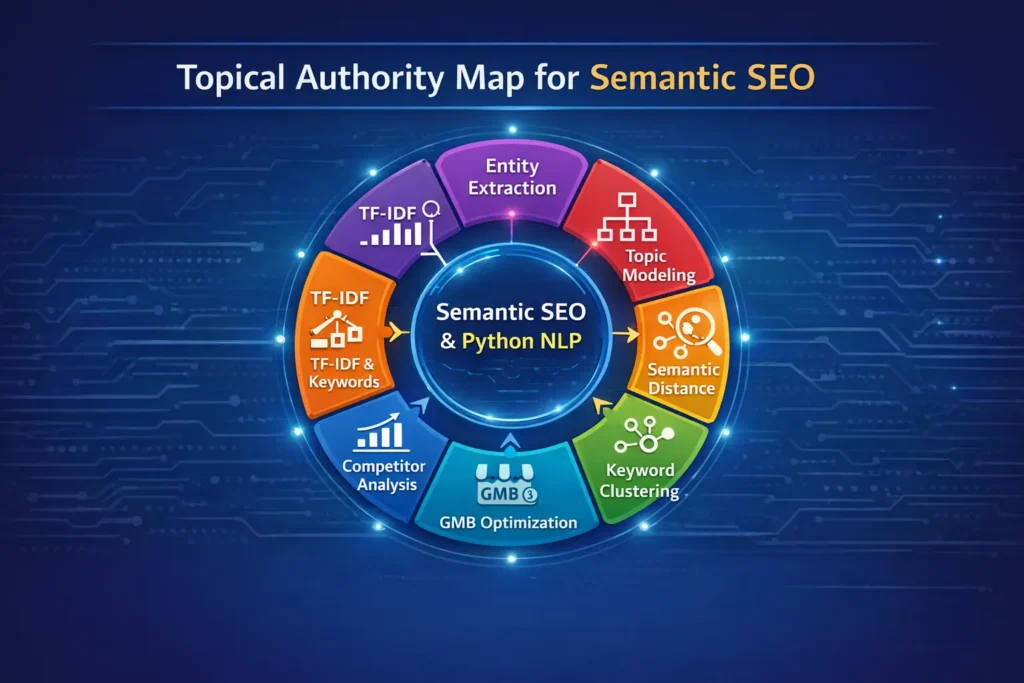
You can use this to plan your content clusters. If you find a cluster of terms that are semantically close but you haven’t written about them, that’s a content opportunity. For a Digital Marketing Agency Florida, this might mean discovering that “voice search optimization” is semantically vital to your core service pages, prompting you to create new, targeted guides.
📌 Expert Note — Strategic SEO Insight:
“Topical authority is built through patterns. Python’s NLP tools expose those patterns, helping you see exactly what Google considers essential for ranking.”
practical implementation of TF-IDF for keyword optimization
Term Frequency-Inverse Document Frequency (TF-IDF) sounds intimidating, but the concept is simple. It measures how important a word is to a document in a collection or corpus. It helps you identify words that are unique and significant to a specific topic, filtering out common words like “the” or “and.”
In Python, the scikit-learn library makes calculating TF-IDF incredibly easy. You can feed it a list of your competitors’ articles and your own draft. The output will show you which terms are statistically significant in the top-ranking content. It moves you away from “keyword stuffing” and towards “term enrichment,” ensuring you are using the specialized vocabulary that experts on the topic would naturally use.
Improving readability and engagement metrics
Technical optimization is crucial, but never forget the human on the other side of the screen. If your content is a wall of text, users will bounce, and all that semantic optimization will be for nothing. Python can help here, too. Libraries like textstat can instantly calculate readability scores like Flesch-Kincaid.
You can programmatically change your drafts. Make a script that marks sentences that are too long or paragraphs that are too full. This makes sure that your content is still easy to find. If you offer logo design services Florida or offer Software Development Services Florida, clarity is your best friend. A site that is easy to read keeps users on it longer, which is a good sign for search engines.
Building a semantic content brief generator
One of the most valuable tools you can build is an automated content brief generator. Instead of manually researching what a writer needs to cover, you let Python do the reconnaissance. Your script can take a keyword, fetch the top SERP results, extract the headers (H1, H2, H3), and pull out the top entities and questions.
This generated brief gives your writers a data-backed roadmap. They know exactly which questions to answer and which sub-topics are non-negotiable. It removes the guesswork from the writing process. If you run a business offering Article Writing Services Florida, this kind of automation allows you to scale high-quality production without sacrificing depth or relevance.
Clustering keywords for better site architecture
A disorganized site confuses both users and bots. Semantic SEO thrives on structure. You can use Python to cluster thousands of keywords into groups based on their semantic similarity. This helps you design a site architecture where related pages link to one another naturally.
You can see the “center of gravity” of your site by looking at these clusters. You might find that you have too much content on one sub-topic and none on another important pillar. This information helps you find a balance in your content strategy. For local businesses, ensuring your Google My Business Optimization Services Florida pages are semantically linked to your local SEO guides reinforces your local authority.
Advanced techniques: Topic Modeling with Latent Dirichlet Allocation (LDA)
Latent Dirichlet Allocation (LDA) is a method that can help you find abstract topics in a group of documents if you want to get really fancy. You don’t need to train it with labeled data because it’s an unsupervised learning method. You just give it text, and it shows you the hidden thematic structures.
Using LDA on a large set of user reviews or forum discussions can reveal pain points you didn’t know existed. If you see a recurring topic regarding “speed of service” or “pricing confusion” in forum data, you can address these directly in your copy. It allows you to speak to the user’s unspoken needs, which is the hallmark of great semantic SEO.
Conclusion: merging code with creativity
Python is a superpower for SEOs, but it is not a replacement for creativity. It is a compass, not the captain. It points you in the right direction, highlights the path, and warns you of obstacles. But you still have to walk the path. You still have to write the stories that connect with people.
When you put together the exactness of code with the feeling of human writing, that’s when the magic happens. You use data to make sure you’re useful and your voice to make sure people remember you. As search engines get better at figuring out what people really want, this combination of art and science will be the only way to win.
Learn more about the Types of SEO to see how different strategies can complement technical and creative approaches. So, fire up that Jupyter notebook, but keep your writer’s soul intact.
📌 Expert Note — Practical Optimization Tip:
“If your primary topic scores low salience in Google’s NLP API, the algorithm thinks your page is about something else. Boosting salience is one of the fastest, most reliable ranking wins.”NLP is the branch of AI that gives computers the ability to understand text and spoken words…”
See Link: https://en.wikipedia.org/wiki/Natural_language_processing
Top 5 FAQs about Python for NLP and Semantic SEO
Do I need to be a professional programmer to use Python for SEO?
Absolutely not. You don’t need to build software from scratch. Most SEO tasks can be accomplished with pre-written scripts and libraries. There is a thriving community of SEOs who share code snippets. You just need to learn the basics of how to run a script and tweak variables. It’s more about “assembling” code than “writing” it.
How does semantic SEO differ from traditional keyword research?
Traditional keyword research focuses on specific strings of text and search volume. It asks, “How many people search for this exact phrase?” Semantic SEO focuses on topics, meanings, and intent. It asks, “What is the user trying to achieve, and what other concepts are related to this?” It prioritizes comprehensive coverage over exact matching.
Can Python help me optimize existing content, or is it only for new posts?
It is incredibly powerful for auditing existing content. You can run your old blog posts through an entity extraction script and compare them to the current top-ranking pages. You will often find that your older content is missing key entities that have become relevant since you first wrote it. Updating these pages is often the quickest win in Semantic SEO.
Is Google’s NLP API free to use?
Google Cloud offers a free tier that is generous enough for most small to medium experiments. You can analyze a significant amount of text without paying a dime. However, for enterprise-level scale, where you are processing thousands of documents daily, you will eventually move into the paid tiers.
What is the most important Python library for a beginner SEO to learn?
If you have to pick one, start with pandas. While it isn’t strictly an NLP library, it is the backbone of data analysis in Python. It allows you to organize your keywords, URLs, and metrics into clean tables (DataFrames) that are easy to manipulate. Once you are comfortable with data handling, moving into spaCy for the actual text processing becomes much easier.

Adrian J. Cole is a digital marketing strategist and SEO expert with a passion for turning complex data into actionable growth strategies. With deep expertise in technical SEO, content optimization, and semantic search, he helps businesses rank higher, engage audiences, and drive measurable results. When he’s not decoding algorithms or optimizing websites, Adrian shares insights on the latest marketing trends to empower professionals and brands alike.