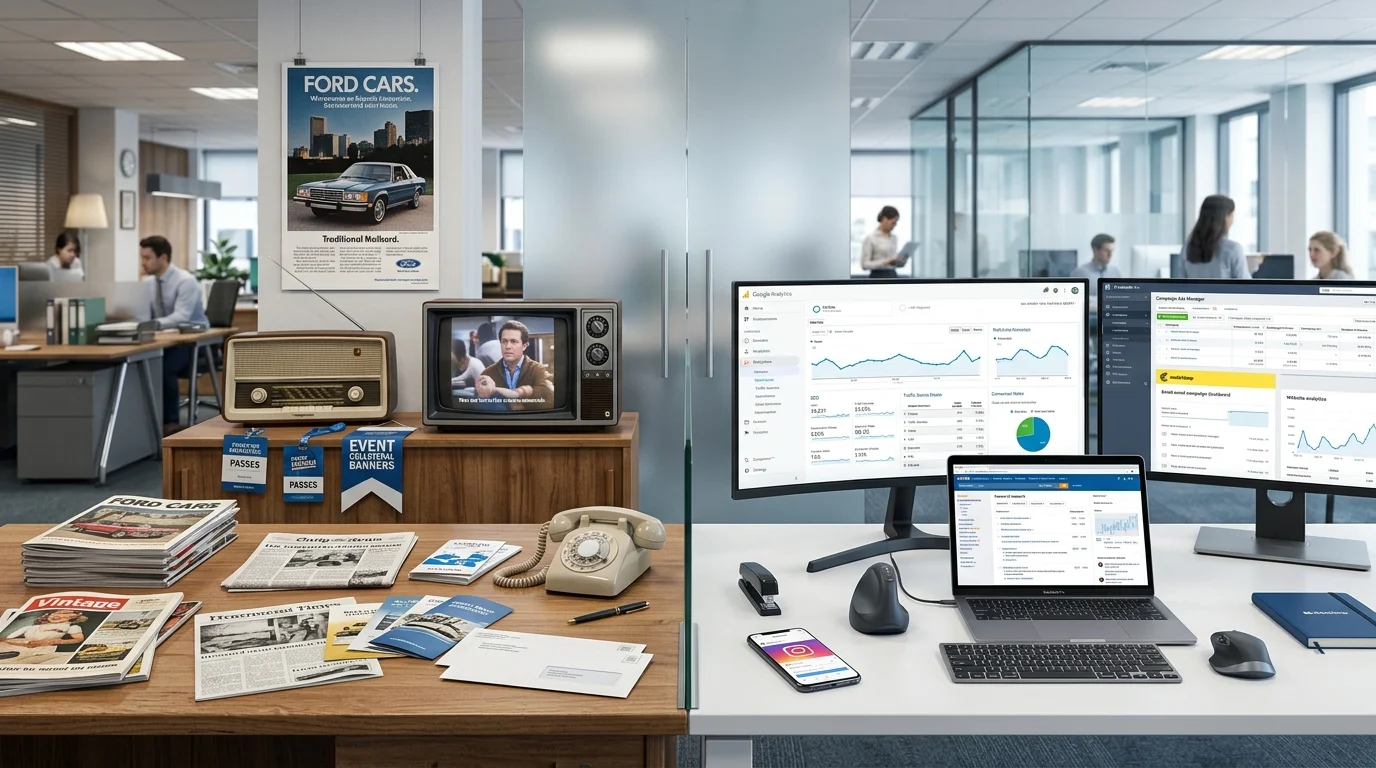
Digital marketing vs traditional marketing is the difference between promoting a business online and offline. Traditional marketing uses physical channels like TV, radio, billboards, print ads, and direct mail to reach broad or local audiences, while digital marketing uses SEO, social media, search engines, email, and paid ads to reach targeted audiences with measurable results. Digital marketing is best for tracking, targeting, and quick optimization, while traditional marketing is best for local visibility, trust, and physical brand awareness.
Ready to improve your marketing strategy? Get a quote from a digital marketing agency in Florida and discover how the right mix of traditional and digital marketing can help your business grow.
Digital marketing gives businesses faster feedback, better targeting, and easier performance tracking, while traditional marketing still works well for local trust, physical visibility, and audiences who respond better to offline channels. Many businesses get the best results when they combine traditional and digital marketing instead of treating them as opposites. Traditional channels can help build broad awareness, while digital channels such as search ads and paid campaigns make it easier to track performance, target specific audiences, and adjust campaigns quickly. For businesses that want to get more value from paid search, working with the best Google Ads agency partner can help you use that flexibility more effectively.
At a practical level, the real difference is the medium. Traditional marketing uses offline formats like print advertising, radio ads, television ads, direct mail, billboards, brochures, trade shows, and face-to-face marketing. Digital Marketing Agency in Florida uses online channels such as SEO, PPC, social media marketing, email marketing, content marketing, video marketing, display ads, and search ads. VistaPrint describes digital as more agile and measurable, while Excelsior notes that traditional methods can still work well for audiences who are less engaged online.
That is why this debate is not really about picking a winner for every situation. It is about choosing the right channel mix for your audience, your budget, and your marketing goals. A local restaurant, a law firm, an e-commerce store, and a home services company may all need very different approaches, even if they operate in the same city.
What Is the Difference Between Digital Marketing and Traditional Marketing?
The clearest difference between Digital Marketing vs Traditional Marketing is how people experience the message. Traditional marketing is usually one-way. A business sends a message through a flyer, newspaper ad, radio spot, or billboard, and the audience receives it. Digital marketing is more interactive. People can click, comment, compare, watch, scroll, sign up, buy, or leave feedback right away. Excelsior highlights this communication difference directly, noting that traditional communication is often one-sided, while digital channels make response and evaluation easier.
Another difference is measurement. With digital tools, you can see website traffic, click-through rate, conversions, ad spend, engagement, and campaign performance in real time. Traditional marketing usually requires slower feedback loops. You may know your ad ran, but it can be harder to connect that exposure to a specific lead or sale unless you build in a coupon code, call tracking number, or event response method.
There is also a trust angle here. Traditional marketing often feels more tangible. A well-designed brochure, direct mail piece, event booth, or local print ad can make a brand feel established. VistaPrint points out that traditional channels can strengthen credibility and brand recognition through physical experiences, while digital channels shine when businesses want agility and measurable results.
Digital Marketing Channels
Digital marketing includes:
- SEO and online visibility
- Google Ads and PPC advertising
- social media marketing
- email marketing
- content marketing
- display ads
- video marketing
- mobile marketing
- influencer marketing
These channels are useful when a business wants targeted advertising, audience segmentation, conversion tracking, and better budget control. They are also easier to test, adjust, and scale.
Traditional Marketing Channels
Traditional marketing includes:
- print advertising
- direct mail
- flyers and brochures
- billboards
- radio ads
- television ads
- trade shows
- local events
- face-to-face marketing
- other physical materials
These channels can still work well when visibility in the community matters, when personal interaction matters, or when your target audience pays more attention to offline media.
Pros of Digital Marketing
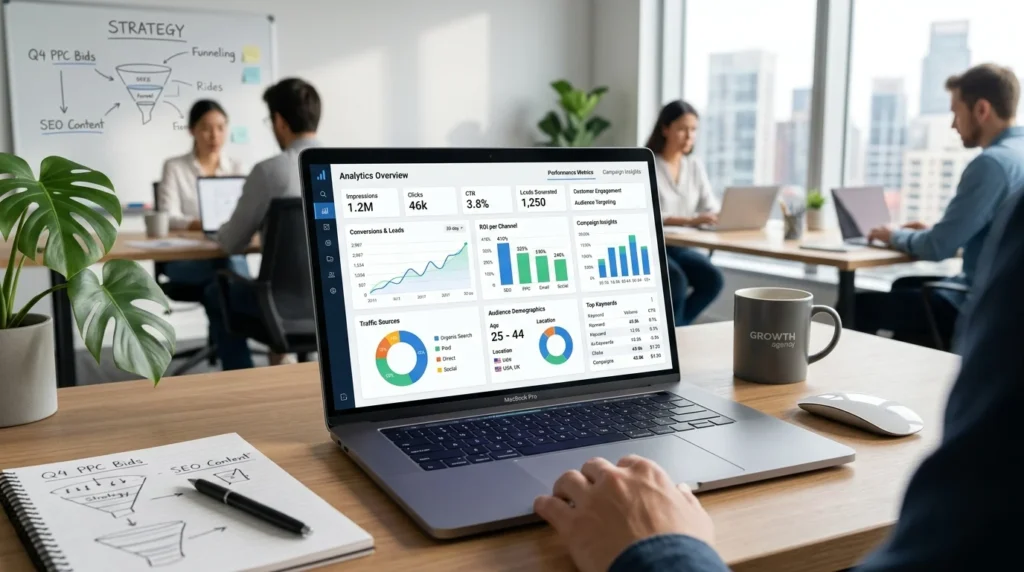
One reason many businesses lean digital first is flexibility. You can launch a campaign today, see early signals quickly, and make changes before too much budget is wasted. That kind of campaign flexibility matters, especially for small business marketing where every dollar needs a job.
Digital marketing also gives you measurable results. You can track impressions, clicks, conversions, leads, and customer engagement in a way that makes decision-making much easier. If one landing page performs better than another, you can see it. If one ad group brings stronger purchase decisions, you can act on it. That level of visibility is a major reason digital channels are often seen as more cost-effective.
Another major advantage is targeting. Digital platforms allow businesses to narrow by location, audience behavior, keyword intent, interests, and even stage in the buying journey. That means a campaign can be much more focused than a newspaper ad or radio placement.
There is also a practical growth benefit. If a campaign is working, it is often easier to scale online than offline. You can increase ad spend, test new audience segments, improve message consistency, and expand into new digital channels without rebuilding the whole strategy from scratch.
Why Google Ads Often Comes Up in This Comparison
When people compare traditional and digital, google ads usually enters the conversation because it shows one of digital marketing’s biggest strengths: intent. Someone searching for a service is already showing interest. That is very different from hoping the right person notices a billboard on the way home.
This is also where budget control matters. A business can adjust bids, monitor conversions, and watch performance metrics more closely than with most offline campaigns. If you are already investing in digital acquisition, pairing paid media with SEO Services Florida can strengthen both short-term traffic and long-term visibility.
Pros of Traditional Marketing
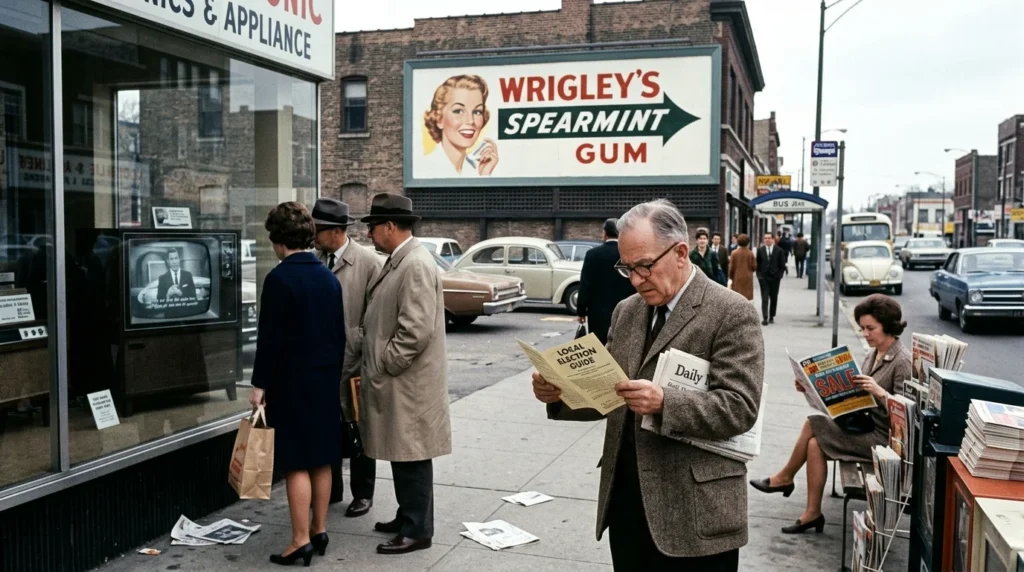
Traditional marketing still matters more than many online-first businesses assume. It can create strong local presence, improve brand recognition, and support customer trust in ways that purely digital campaigns sometimes do not. A business card handed over in person, a booth at a trade show, or a direct mail campaign sent to a defined neighborhood can feel more real than a banner ad.
That physical presence matters in certain industries. Businesses that rely on local marketing, community recognition, or relationship-building may benefit from traditional channels because they place the brand directly into everyday life. A home improvement brand at a local event, for example, may leave a stronger impression than another sponsored social post.
Traditional marketing can also work well for audiences that are less active online or less likely to respond to digital tools. Excelsior explicitly notes that traditional marketing can be effective for people who are less engaged with the internet. That matters more than some marketers admit, especially in communities where habits still favor offline touchpoints.
Another strength is memory. Tangible marketing materials often stay around longer. A flyer on the fridge, a postcard on a desk, or branded packaging in someone’s hand can create repeated exposure in a way digital impressions do not always match.
Cons of Digital Marketing
Digital marketing is powerful, but it is not automatically easy. The online space is crowded, and attention is fragile. Excelsior points out that digital marketing can be easier to measure, but businesses still need strategy and creativity to stand out.
That is one of the hidden downsides. Because digital campaigns are accessible, many businesses run them without a clear plan. They launch search ads with broad keywords, post on social media without a message strategy, or create content without thinking about search intent, conversions, or audience reach.
There is also platform dependency. Your performance can shift based on ad costs, algorithm changes, rising competition, or weak landing pages. For example, google ads cost and google ads pricing for small businesses can vary based on keyword competition, Quality Score, and bidding strategy, which means poor setup can make digital look more expensive than it really is. Google’s own documentation says Keyword Planner can show keyword ideas along with estimates for searches and the cost to target them, and Quality Score reflects how relevant and useful your ad and landing page are for a given keyword.
Digital also asks for consistency. Campaigns need monitoring, content needs updating, and user interaction needs attention. If a business wants digital results without ongoing effort, frustration usually follows.
Cons of Traditional Marketing
Traditional marketing has its own limits. The biggest one is measurement. It is often harder to know which print ad, flyer batch, or radio mention led to a real customer. Without clear attribution, decision-making becomes slower and more based on guesswork.
Traditional channels can also be less flexible. Once brochures are printed or a billboard goes up, changes are harder and more expensive. Digital can pivot much faster. That difference matters when businesses want to test offers, adjust creative, or improve weak messaging in real time.
Another drawback is targeting precision. Traditional media can reach broad groups, but it is often less precise than digital audience segmentation. You may gain exposure, but not always to the people most likely to buy.
And then there is cost efficiency. Traditional marketing can be worthwhile, but it can also become expensive if the audience fit is weak. A business spending heavily on local print without tracking response may get visibility without measurable outcomes. That is why channel selection should follow strategy, not habit.
Digital Marketing vs Traditional Marketing: Which Works Better for Different Businesses?
| Factor | Traditional Marketing | Digital Marketing |
| Main Channels | Print ads, flyers, brochures, billboards, radio ads, TV ads, direct mail, trade shows, events, face-to-face marketing | SEO, Google Ads, PPC, social media, email marketing, content marketing, video marketing, display ads, mobile marketing |
| Audience Reach | Strong for local and offline audiences | Strong for local, national, and global audiences |
| Targeting | Broader targeting, less precise | Highly targeted by location, interests, behavior, keywords, and demographics |
| Communication Style | Mostly one-way communication | Two-way communication with instant feedback and interaction |
| Measurability | Harder to track exact results | Easy to track clicks, leads, conversions, ROI, and campaign performance |
| Speed of Results | Can take longer to measure impact | Faster feedback and quicker optimization |
| Flexibility | Harder to edit once launched | Easy to update, pause, test, and scale |
| Cost Control | Often fixed spending with less control after launch | Better budget control with real-time adjustments |
| Best For | Local trust, community presence, physical visibility, older or less-digital audiences | Lead generation, website traffic, online visibility, measurable growth, targeted campaigns |
| Pros | Tangible presence, stronger physical brand recall, local credibility, useful for events and community marketing | Better targeting, measurable results, cost-effectiveness, real-time data, easier optimization, wider reach |
| Cons | Limited tracking, less flexibility, broader targeting, can be expensive for unclear results | High competition, requires ongoing monitoring, platform dependency, can waste budget if poorly managed |
| ROI Tracking | More difficult to connect directly to leads or sales | Easier to connect ad spend to clicks, leads, and revenue |
| Customer Journey Fit | Better for awareness and local exposure | Better for awareness, consideration, conversion, and retargeting |
| Brand Experience | Physical, tangible, memorable | Interactive, personalized, data-driven |
| Best Use Case | Trade shows, local campaigns, print promotions, radio, direct mail | Search campaigns, SEO, Google Ads, email funnels, content strategy, remarketing |
The best answer to Digital Marketing vs Traditional Marketing is: it depends on your audience, your offer, and how people make purchase decisions in your market. That may sound simple, but it is actually the most honest answer.
Best Use Cases for Digital Marketing
Digital marketing is usually the better fit when:
- You need measurable results
- You want lead generation quickly
- Your audience spends time online
- Your business depends on search behavior
- You want better control over the budget and targeting
- Your team is ready to test and optimize
It is especially useful for service businesses, e-commerce brands, local businesses targeting search traffic, and companies that care about analytics, campaign performance, and conversion tracking.
A business investing in online growth often needs more than one digital channel. Search ads, SEO, content marketing, and social campaigns can work together instead of competing with each other. If you are evaluating who should help manage that mix, Learn more about our How to Choose the Best Digital Marketing Agency in Florida for a practical breakdown of what to look for.
Best Use Cases for Traditional Marketing
Traditional marketing is often a better fit when:
- your audience trusts offline media more
- you rely on local foot traffic or community presence
- physical materials support your sales process
- relationship-building matters more than immediate clicks
- your brand benefits from in-person visibility
This is common in local services, real estate, regional events, education fairs, medical outreach, home services, and businesses where personal trust is part of the sale.
When a Mixed Strategy Works Best
Many businesses get better results when they combine offline visibility with online tracking and follow-up, and the American Marketing Association also explains how traditional and digital marketing can work together to support stronger overall performance.
American Marketing Association article on how traditional and digital marketing work together
Good for supporting the idea that both channel types can complement each other, and for reinforcing the interaction/performance comparison in a more industry-recognized source.
A simple example: a local event drives awareness through flyers, local radio, and signs, while digital marketing captures demand through SEO, social media, event pages, email reminders, and paid search. One creates physical visibility. The other turns attention into measurable action.
That mixed approach is often where the best ROI lives.
Cost, Reach, and ROI: A More Honest Comparison
People often assume digital is always cheaper and traditional is always expensive. Real life is messier than that. Digital can be very cost-effective, but it can also burn through budget if targeting is poor. Traditional can be expensive, but it may still deliver strong returns if it reaches the right audience with the right message.
The better question is not “Which one costs less?” It is “Which one gives us stronger outcomes for this audience and this offer?” If your product needs local trust and repeated physical exposure, traditional may work better. If your customers are actively searching online and comparing options, digital usually has the edge.
This is also where the difference between broad reach and useful reach matters. Ten thousand impressions mean very little if they do not move the customer journey forward. A smaller audience with stronger intent can outperform a larger audience with weak relevance every time.
A Quick Word on Google Ads in the Digital Mix
Because your brief includes google ads budget for small business, it is worth saying this clearly: Google Ads is one of the strongest examples of digital marketing’s intent-driven power. It lets businesses appear when users are actively looking for a solution. That makes it very different from interruption-based marketing.
But that does not mean every business should throw budget into it without structure. Campaign setup, keyword selection, landing pages, and offer clarity still decide whether paid search becomes a growth tool or a budget leak. Businesses that want help with that side of digital strategy often work with a Google Ads Management Agency in Florida to improve targeting, message fit, and campaign performance.
How to Choose Between Digital and Traditional Marketing
If you are trying to choose, start with these questions:
- Where does my target audience actually pay attention?
- Is my goal awareness, leads, sales, or local trust?
- Do I need measurable short-term performance or slower brand building?
- Can I support this channel consistently?
- What would a successful outcome actually look like?
Those questions usually reveal the answer faster than any trend report. Strategy-first thinking is one of the clearest E-E-A-T signals in marketing content because it shows decision-making based on business goals instead of hype.
If your audience researches online, compares options, and responds to search, social, or email, digital likely deserves a larger share of your effort. If your audience responds to physical materials, local touchpoints, or community visibility, traditional still deserves a seat at the table.
To get both reach and measurable response, a blended marketing plan is usually the smartest approach. Working with a full-service digital marketing agency in Florida can help you connect SEO, PPC, content, and broader marketing strategy into one consistent plan instead of running scattered campaigns.
Final Thoughts
Digital Marketing vs Traditional Marketing is not a battle where one side wins forever. Digital marketing usually offers better targeting, more measurable results, and more campaign flexibility. Traditional marketing still offers credibility, physical presence, and strong local brand recognition. The right choice depends on your audience, your budget, and the kind of action you want people to take.
If you want quick testing, real-time data, online visibility, and easier conversion tracking, digital is often the stronger starting point. If you want tangible exposure, community trust, and physical reminders that stay in front of people, traditional still has real value.
Most businesses do best when they stop asking “Which one is better?” and start asking “Which mix makes the most sense for us right now?” That question usually leads to smarter marketing, better customer engagement, and more useful results.
If you want to understand the main channels better, explore our guide on types of digital marketing.
FAQs
1. What is the difference between digital marketing and traditional marketing?
Digital marketing promotes a business through online channels like SEO, social media, email, and paid ads, while traditional marketing uses offline channels such as print ads, TV, radio, billboards, and direct mail. Digital marketing is easier to track and target, while traditional marketing is often better for broad or local brand awareness.
2. Which is better, digital marketing or traditional marketing?
Digital marketing is usually better for targeting, analytics, lead generation, and budget control, while traditional marketing is better for physical visibility, local trust, and offline audience reach. The better choice depends on your business goals, target audience, and marketing budget.
3. Is digital marketing cheaper than traditional marketing?
Digital marketing is often more cost-effective because businesses can control ad spend, target specific audiences, and measure campaign performance in real time. Traditional marketing can cost more upfront, especially for TV, print, or billboard placements, and results are usually harder to track.
4. Can digital marketing and traditional marketing work together?
Yes, digital marketing and traditional marketing can work together effectively. Many businesses use traditional marketing for local visibility and brand awareness, then use digital marketing to drive traffic, generate leads, and track conversions.
5. Which type of marketing is best for small businesses?
Digital marketing is often the better starting point for small businesses because it offers better targeting, measurable results, and more flexible budget control. Traditional marketing can still work well for local promotions, events, and community-based brand awareness.

Adrian J. Cole is a digital marketing strategist and SEO expert with a passion for turning complex data into actionable growth strategies. With deep expertise in technical SEO, content optimization, and semantic search, he helps businesses rank higher, engage audiences, and drive measurable results. When he’s not decoding algorithms or optimizing websites, Adrian shares insights on the latest marketing trends to empower professionals and brands alike.